Recently I realized that I've been sleep deprived for most of my life. "Get 8 hours of sleep" is just another piece of sound advice that I've ignored. After listening to a podcast[1], I was convinced I could no longer avoid this advice. I resolved to turn off all screens an hour before I wanted to be asleep and to make sure that I had enough time to sleep. Though I saw benefits, I found my heart pounding and my mind racing as I tried to sleep. Meditation, yoga, lights off, writing in a journal helped some, but not enough. I finally came up with this parable to help.
We all have two types of warriors: awake warriors and asleep warriors. The awake warriors are ambitious and courageous. They help us face the obstacles of the day. The sleep warriors help us to rejuvenate at night. My problem is that the awake warriors dominate. The awake warriors have been given the best weapons and fastest horses to help extend my day so that I could have more fun, succeed in school, and help care for small children. As a result, they have received my praise and support. I throw parades in their honor.
Meanwhile, the sleep warriors have been defeated. I have taken away their weapons and horses, ignored their pleas. As a result, I wake up every morning exhausted and unready for the day.
The awake warriors dominate, so they keep me awake to waste time on screens: binge watching shows, playing mindless games. There is no longer a meaningful purpose. They just do it because they are used to it.
But that is the past.
This last week I called all warriors to a counsel.
I told the awake warriors that I am taking away all of their weapons and fast horses and giving them to the sleep warriors. I told the awake warriors that if they didn't yield to the sleep warriors, that I would cut out their tongues, gouge out their eyes, cut off their hands. I told them that I appreciated what they had done for me in the past, but that their glory days were over.
I told the sleep warriors to rise up, take courage. That I would provide every resource to them. That they were my new favored warriors. That I would defend them, give them the best weapons and fastest horses.
That night, The sleep warriors helped me have the most restful sleep in a long time.
Then I realized that I was too harsh to the awake warriors. I realized that I still needed them. I needed them to give me courage during the day. To remind me of my responsibilities during the day. To drive me during the day. Instead of a battle at bedtime, I decided it would be a changing of the guards. It was time to call all warriors to counsel. Give the awake warriors a final say for the day, but them hand guard over to the sleep warriors. The awake warriors could rest knowing that I would give them full attention in the morning and throughout the next day. The sleep warriors felt respected as they were honored to receive full charge over me with out a battle. They would have energy to help rejuvenate my body while I slept.
I now have more hope for the future since instead of spending energy on battling, it will be replaced with collaboration.
Resources:
[1] https://www.successpodcast.com/show-notes/2018/1/3/everything-you-know-about-sleep-is-wrong-with-dr-matthew-walker
[2] Thanks to Adam from http://move-aware.com for being my mentor while I worked through his APART worksheet.

Friday, March 6, 2020
Thursday, July 25, 2019
My Experiment with the Personalized Diet
TL/DR;
I tested my blood glucose levels every 30 minutes for 2 hours after eating. My personal results:
- Bad: grains (wheat, corn, rice, oats) and desserts cause my blood glucose to spike.
- Good: animal protein (meat and eggs), vegetables, fruit, potatoes, seeds, nuts are best for my blood sugar.
- Walking for 15-20 minutes after eating any food restores blood glucose to normal levels
- I lost 2" of belly fat in 2 month after doing this experiment, mostly from walking after every meal that I know causes a blood sugar spike (probably small diet change as well).
- There are other factors than just food that affect blood glucose levels (stress?)
I came across the research of Dr. Eran Segal and Dr. Eran Elinav from the Weissman Institute in Israel regarding blood glucose response after eating. The surprising results of their study is that the perfect diet is different for each of us, which makes perfect sense to me.
In this post I'll share the results of an experiment on myself to try and determine my personalized diet. The approach is to take blood glucose measurements every 30 minutes from when you take your first bite of food. I used the Care Touch glucose monitor as it had the cheapest cost combined for monitor and test strips (I've taken hundreds of measurements). All of the plots below include an average measurement over 2 hours (dark line) with maximum and minimum measurements included as shaded regions. The first plot is for all measurements and the following plots have an overlay of specific meal categories (including or excluding macronutrients or food groups).
I'll describe the first plot in detail to help get you oriented. The vertical axis is blood glucose level. The bottom axis is "Minutes after taking the first bite". Before I started eating, I would take a measurement, that is represented as "0 minutes". The average reading is a dark line. The minimum and maximum levels create a shaded region. All measurements fall somewhere in the shaded region. All other plots overlay a similar plot on this first plot. I'll put the plots in a progression of how I have tried to manage my blood sugar levels. Every plot has a dashed gray line at 100 mg/dL, since this is an expected level between meals. The dashed red line at 140 mg/dL is a recommend upper limit. You can see that I regularly exceed this limit.

The next plot is of desserts (ice cream, donuts, toaster strudels). Occasionally I go on a "sweet fast", which is a logical thing to do looking at the higher average and overall levels. By eliminating these treats, I expected it would help lower my levels.


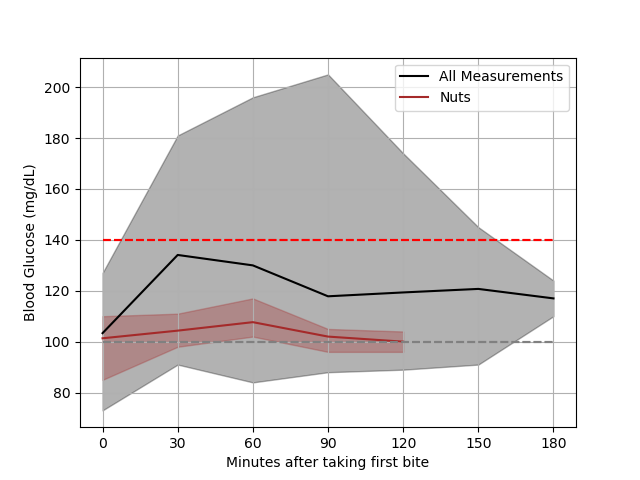

The salads all included dressing (mostly ranch dressing). They also include romaine lettuce, spinach, mixed greens, tomatoes, broccoli, brussel sprouts, bell peppers, red onion, chicken, eggs, carrots, cucumber, artichoke hearts. The salad that gave the maximum values also had sunflower seeds, pepitas (pumpkin seeds), corn, peas and croutons. The effect of seeds can be seen in the previous plot.

The "animal" meals were meals of only food from animals (e.g. bacon and eggs). As expected these high protein, no carb meals had no impact on blood sugar. It's important to note that blood glucose level is only one measure of health. I'm sure that eating only bacon and eggs wouldn't be considered healthy.


Regardless of what I ate, I made a valuable discovery. GO FOR A WALK AFTER EATING. If I exercised lightly after eating (take a walk for 15 or more minutes), I could keep my levels below 140 and my levels would even drop to normal. Below is a plot for foods for which I measured my levels without exercising and then with exercising. These include: pot roast, Mexican food, oatmeal, donuts, vegetable lasagna, s'mores. Note that the time of exercise varied

One of the recommended foods for Type II diabetes is oatmeal. I try to be healthy with my oatmeal so I eat it with raisins and almonds (no milk, sugar, or other sweetener). The drop at 90-120 minutes is good but the initial spike was unexpected. I ended up testing each ingredient separately. Oatmeal was the prime culprit, raising my levels by around 30 for an hour (I ran out of strips). The almonds reduced my levels over 90 minutes. The raisins raised levels only slightly and only at 30 minutes.

Here are some other results.
Mexican food is worse than average. An exception was Chipotle's salad bowl (chicken, veggies, brown rice, pico de gaio, sour cream), though I only had one data point (a level of 111 after 30 minutes).


In an attempt to minimize dependencies, I had my wife make whole wheat bread. She ground kernels of wheat into flour and made bread with water, salt, oil and yeast. I then ate one slice of bread first thing in the morning with nothing else. I was surprised at how much my blood glucose levels varied at 30 minutes (112 to 167). My conclusion is that there is another factor affecting blood glucose besides "what you eat". For example, the stress hormone cortisol elevates blood sugar and possibly that is the cause of this variation.

Tuesday, May 7, 2019
The Benevolent Atheist
I saw this on the /r/Atheism subreddit
What gets a person into heaven, being good or believing in God?
Of course, the original poster wasn't interested in this answer. It was really a use of logical fallacy to justify being an atheist. Still, both questions are pointless since atheist don't believe in an afterlife. For a meaningful debate, it's important to frame a question within bounds of shared beliefs and assumptions. For example, both atheist and theist should agree to these points:
If an Atheist is a good person, will they go to heaven or hell? If hell, then I don't believe in a God that punishes good people for eternity. If heaven, then what's the point of believing in God?Another way to ask this would be:
What gets a person into heaven, being good or believing in God?
Of course, the original poster wasn't interested in this answer. It was really a use of logical fallacy to justify being an atheist. Still, both questions are pointless since atheist don't believe in an afterlife. For a meaningful debate, it's important to frame a question within bounds of shared beliefs and assumptions. For example, both atheist and theist should agree to these points:
- There is some universal measure of being good (kindness, do no harm, show respect, etc.)
- The world is a better place if people are good
- We are born into this world
- While we are alive, we behave with some level of goodness
- After we die, we cannot measurably act on this world or the people in it
So our new question with shared understanding is:
What is more likely to influence a person to be good while alive, being an atheist or believing in God?
There may be the standout "benevolent atheist" or "wicked theist", but what about a million people? Would they collectively be more benevolent as atheists or theists?
That is a worthwhile debate.
An interesting post on the same subreddit
Sunday, May 5, 2019
I'm Always Late
Why am I late?
- I really didn't want to go, but obligation kept nagging at me until I finally pulled it together and went.
- I schedule my activities too close together (I can mow the lawn, put on an extra coat of paint, shower, get ready and drive through uncertain traffic to the event; all in one hour because each activity only takes about 15 minutes). I didn't account for time to transition between events (setup, cleanup, etc).
- I always like what I am doing more than anything else. That's because to do something else, I need to clean up what I am doing and then prepare for the other activity. This can involve a change of clothes, set of tools, etc. Another aspect is that we always have a simulation running in our brain. Sometimes it can take a while to boot-up that simulation, so powering it down and firing up a new one can seem like too much work.
I once talked with a wise elderly lady who told me that she would rather be an hour early than five minutes late. There is great wisdom in this. Some examples:
- Flying on an airplane (missing a flight by even 10 seconds has painful consequences)
- The birth of a child (I had a childhood friend that was born in the back seat).
- A movie (I missed the rolling opening story for the first Star Wars movie and was confused for years on what the story was).
- A job interview
- A court hearing (I was a week late once. The judge wasn't very merciful)
What have I done about this?
- Don't cram activities together. Enjoy a little peaceful time between events. In our sometimes hectic life, this down time can be quite pleasant.
- Follow the principle "on time instead of in time". With "on time" you have a chance to fully transition to the activity with a buffer to account for unexpected obstacles. With "in time", your heart is still racing as you take your seat, distracted by the trauma of trying to make it "in time".
- Imagine the good things about an activity you don't want to go to. I didn't want to go to a funeral once, thought about the people I hadn't seen for a while, and then had a life changing experience as a result.
Wednesday, February 7, 2018
Global Warming: Here's a better story
I think we need to change the story we are using to solve the anthropogenic climate change (ACC), global warming problem. What do I mean? Well, a story needs:
- A good problem or conflict to resolve
- A character that:
- We can identify with
- Who ends up being the hero that solves the problem
- Who grows and learns about themselves in the process
- The story needs to be believable, credible.
What is the ACC story?
We are facing the worst ecological disaster since the extinction of the dinosaurs. People caused this by our reckless burning of fossil fuels. People must give up driving cars and all modern conveniences and become vegans in order to stop the disaster. We also need to give politicians more power so they can be the heroes.
Not a very fun or engaging story. It reads more like a sad tragedy or horror. The failures are:
- A character we can't and don't want to identify with.
- Our character isn't the hero.
- We didn't learn anything good about ourselves.
- There's not a credible hero or solution to the problem.
- The conflict seems exaggerated since it puts all blame on humans leaving out other causes such as the earth being in a 400+ years of thawing since the last ice age, polar bear deaths are due to hunting for population control, etc. You can read my previous post here on these facts.
Here's a better story:
As our population grows and third world countries rise above poverty, our resources will need to be shared more effectively. This includes food (from farms and fishing), fresh water, raw materials (metal, plastic, wood, etc.) As always, we find a way to adapt. This includes sustainable processes, new technologies, new economies, open scientific exploration and understanding of the problem, etc. Through this transformation we realize that mankind has been continually evolving, from hunter gatherer, to farmer, to cities; traveling on foot, then on beast, then on machine. As borders disappear due to cities overlapping, continued legal migration, the Internet and social media, we learn that greater collaboration is needed.
Why is it better?
- We can better identify with the character.
- The hero actively solves the problem.
- The hero grows and learns about themselves.
- The story is more believable because we are addressing current observable trends instead of a future calamity predicted by a computer model.
Saturday, January 6, 2018
Review of Glacier Change and Sea Level Rise (live public talk) by Dr. Alex Gardner
This is a review of a talk found on YouTube “Glacier Change
and Sea Level Rise” by Dr. Alex Gardner from JPL. https://youtu.be/ZJYs8L84L4s
Accepted Facts
The science in this presentation is very impressive.
The following are facts that I accept
- CO2 is increasing
- Global Temperatures are rising
- Oceans are rising
I agree that this can have an enormous economic impact as we
try to address increased flooding in coastline areas and other costs.
Some helpful points from the video:
At 4:58, The discussion of solar heating and thermal cooling.
At 7:38, the presentation of ice cores for determining
climate history (CO2 levels and temperature levels)
At 10:42, the current CO2 levels
At 15:28, the presentation of rising temperatures and the
discussion of the hiatus.
At 16:39, the discussion of how much of an impact a small
temperature change can have.
At 17:08, the discussion of rising sea levels
At 19:24, the mostly negative effects of climate
change. I give Dr. Gardner credit for
actually showing a positive consequence, such as more land and improved
agriculture (this shows intellectual honesty).
At 21:03, the melting of the glaciers
At 25:37 to 27:59, the discussion of the impressive sensors
that NASA has to measure glacier loss and sea level rises.
At 28:00 to 33:30, the discussion of what is happening today
At 43:40 to 46:44, presents impressive future satellites
that will be deployed to help measure changes.
At 47:20 An argument for the attention to Climate Change is
that the attention has resulted in investment that has contributed to
improvements to the science.
Disputed Science
I dispute the public discussion of climate change science because
it excludes the following points:
- Ice loss has been occurring for 400 years and is primarily due to an over accumulation of ice in the last mini ice age
- As the earth warms, the thermal emissions get proportionally greater with an increased counter cooling effect.
- Model predictions of the future are unreliable.
I discuss these points in further detail.
Lacks full Disclosure of Causes for Climate Change
The IPCC technical report states our current glaciers are
out of balance since the build up during the “Little Ice Age” and have been
melting for about 400 years and will continue melting even without man-made
warming .
“There is high confidence that current glacier extents are
out of balance with current climatic conditions, indicating that glaciers will
continue to shrink in the future even without further temperature increase.”[1]
The IPCC technical report is the only place I’ve seen this
information and I’ve never heard it discussed by climate change supporters.
59:45 A question was asked about when was the last ice
age. This would have been a perfect
opportunity to talk about the “Little Ice Age” but the question wasn’t
answered.
Model predictions of the future are unreliable
I have over a decade of experience in scientific modeling. This experience includes using real world
data to validate the models. All models
use approximations and the smallest thing can result in an inaccurate
model. The “Butterfly Effect” is proof
of the instability in predictive models for complex systems. While the power of modern computing and
sophistication of the science that goes into models is awe inspiring, it can
blind the scientist to these limitations.
35:00 “What happens next?” The presentation begins a lengthy
discussion of numerical modeling which is used to predict 50 to 100 years in
the future.
Dr Gardner shows his bias towards the value of models with
statements like:
·
“One thing we can be certain of” (13:18),
·
“Fantastic ocean models” (39:56)
·
“We know where it’s going in the future” (35:57)
·
“The question is not if this is gonna happen..
That was already determined” (47:44)
The problem that I have with model predictions is that you
can’t predict the future. While CO2
levels and temperature are strongly correlated, there are many other factors
that prevent models from predicting decades into the future.
1.
Water is a more significant greenhouse gas than
CO2, yet our models can’t tell what will happen as the earth warms. Will more water evaporate, creating a blanket
that blocks the sun and results in cooling?
2.
There are large natural cycles in CO2 and temperature. What natural forces were at play? How will nature respond to increased CO2 over
the coming decades? For example, increased
CO2 results in more plants. Will a
greener planet clean up the CO2 naturally?
I might accept a model predicting trends a few years into
the future but decades as shown in:
·
Presentation of temperatures at the end of the
century (13:18)
·
Shows a 1 to 2 meter rise in sea levels over the
next century (18:31)
·
Simulation of melting glaciers runs to the year
2500 (36:55)
Dr. Gardner does provide acknowledgement of some of the
limitations
·
“The problem is that we only have a very short
record” (38:56)
·
“We’re working on the details of how much and
how fast” (47:44)
Disregard for Thermal Cooling
As the earth heats up, the amount of thermal cooling is
proportional to the 4th power of temperature. I ran MODTRAN simulations to determine that
temperature changes were about a quarter of the predictions found in the literature
at the time (2009).[2]
The latest IPCC technical report seems to have corrected this mistake, however
there seems to be a general disregard for this powerful cooling effect.
At 50:00 in the video, the first question from the audience
was regarding runaway temperatures after all of the ice melts. Dr. Gardner’s response included no insight on
how the earth temperatures would be moderated by thermal cooling. It’s not the ice that is keeping earth cool.
At 51:42 in the video, Dr Gardner does allude to this
cooling by stating that temperature rises more slowly as CO2 levels get higher
and higher.
Attitudes of Alarmist and Deniers
I also take issue both Climate Change Alarmists and Climate
Change Deniers on the following points:
·
The attitudes they take towards each other
·
The sensationalism of information
·
Ignoring information
·
Taking a balanced approach instead of all or
nothing
An example of attitudes toward others is found at 3:24 when Dr
Gardner tells the story of his surgeon asking if humans are contributing to
climate warming. He then refers to
climate change as “a done deal” and wonders why “we haven’t been able to reach
these smart individuals”. The audience
laughs. He brings up his surgeon again
in a dismissive tone at 20:46.
Regarding sensationalizing, both sides use it to support
their viewpoints. For example, a climate
change denier might point to a freezing winter scene and ask sarcastically, “What
Global Warming?”
At, 23:40 a video of an iceberg calving is shown. It’s stated that this represents 1% of all
the ice in New Zealand, but the video is of a glacier in Greenland. Creating a statistic using an unrelated smaller
land mass is sensationalizing. Dr.
Gardner states that the calving event was so large that it was measured by a
seismograph in North Dakota. This is
sensationalizing the event. Is climate
change creating much larger seismic calving events or do regular, seasonal calving
events also trigger seismic readings?
Extreme events happen so let’s be honest when they are due
to normal seasonal changes.
Perspective
At 48:03, the perspective is given showing that on a tiny
spec of a planet, all known life exists.
I believe that man has stewardship over the earth and a
responsibility to take care of it. The
problem is that if we put an imbalanced focus on climate change, we may
allocate more attention on this problem than potentially more critical
environmental concerns such as managing our resources: the oceans, forests,
etc. and limiting other sources of
damaging pollution.
Let’s be more honest about climate change. Man doesn’t have as much to do with climate
change as the alarmists claim and we can’t know what will be happening 50 to
100 years in the future.
Tuesday, August 15, 2017
Until I met one
I looked down on Black people. Until I met one.
I made fun of Mexicans. Until I met one.
I was afraid of Russians. Until I met one.
I laughed at the Polish. Until I met one.
I thought Iranians were crazy. Until I met one.
I thought Jews were weird. Until I met one.
I thought Muslims were scary. Until I met one.
I really hate your kind of people...
You know what to do.
Subscribe to:
Posts (Atom)