
Showing posts with label Diet. Show all posts

Sunday, June 15, 2025

Nonviolent Eating: Relax Your Eating for Better Health

TL/DR;

  • I used the Dexcom Stelo "Continuous Glucose Monitor" or CGM.
  • I confirmed the same lessons from previous experiment. My Experiment Results
    • Foods high with grains or processed sugars cause blood glucose levels to rise
    • Walking after eating helped to bring levels into acceptable ranges
    • Stress can cause levels to rise more (even with identical foods).
  • New insight:
    • Nonviolent eating (I made this term up), or mindful eating in a relaxed, non-rushed manner can help reduce blood glucose spikes
Six years ago I did an experiment with taking periodic blood glucose  measurements after eating. It took hundreds of finger pricks.

Luckily, Dexcom now has a non-prescription, over-the-counter, continuous blood glucose monitor which provides readings every 5 minutes. I won't review all of the data because it basically confirmed what I discovered with my previous experiment.

Tuxedo Cake

The first surprise was on Memorial Day (May 26, 2025). We had my daughter and her family over. It was a relaxing, enjoyable day with swimming and ping-pong. At 12:45 PM, we had hamburgers, watermelon, etc. Then at 2:52 PM, we broke out the Tuxedo Cake from Costco. I ate a slice, then another, and then had a few more smaller pieces. I thought to myself, "This is really going to spike my blood sugar!"
Costco Tuxedo Cake

I went back to playing ping-pong with my grandson and then checked my levels later in the Stelo app. The green circle in the image marks the time when I ate the cake. My blood sugar never spiked (highest was 118 mg/dL an hour later). I figured it was being active (playing ping-pong) that kept it low. 


Blood Glucose After Eating Tuxedo Cake

Oatmeal

These next measurements were for times I ate oatmeal for breakfast. The only thing I add is raisins, roasted almonds, and sea salt. The captions describe the differences for three days.

Instant Oatmeal


Whole Oats, Walk after


Relaxed Eating (Whole Oats, no walk)

The second measurement I went on a walk just as it was spiking, bringing down my levels. The last measurement (June 5, 2025), I decided to actually take a break to focus on eating. I put on music from a relaxing playlist and I didn't do any work. 

I only discovered this relaxed eating the last few days that I had left on the sensor, but I applied the approach at every meal with noticeable reductions in blood glucose levels.

Nonviolent Eating

The way I think of it is as a hunter-gatherer out on the savanna. You're picking nuts and berries and eating as you go. You are very alert to any dangers, so you throw the food quickly in your mouth and munch it down quickly. You're telling your body "hey, I may need this to run away from a lion, so convert it to ready energy." This is "violent" eating, because you are in fear of violence while eating.

You bring some of the food back to your dwelling and the hunters just got back with a kill. You all sit, relaxed in the safety of your group and eat a relaxing meal. This is "nonviolent" eating, since you are not in fear of violence while eating. 

The goal is to create a mindful situation for your eating, where you aren't binging or rushing. You calm your mind and focus only on eating. You aren't thinking ahead to the next task or problem.




Thursday, July 25, 2019

My Experiment with the Personalized Diet

TL/DR; 
I tested my blood glucose levels every 30 minutes for 2 hours after eating. My personal results:  
  • Bad: grains (wheat, corn, rice, oats) and desserts cause my blood glucose to spike.
  • Good: animal protein (meat and eggs), vegetables, fruit, potatoes, seeds, nuts are best for my blood sugar.    
  • Walking for 15-20 minutes after eating any food restores blood glucose to normal levels
  • I lost 2" of belly fat in 2 month after doing this experiment, mostly from walking after every meal that I know causes a blood sugar spike (probably small diet change as well). 
  • There are other factors than just food that affect blood glucose levels (stress?)
I've been unsuccessfully trying to lower my blood sugar ever since I was told that I have prediabetes.  Even if you don't have prediabetes, elevated blood sugar after eating may cause weight gain and contribute to a host of metabolic diseases.

I came across the research of Dr. Eran Segal and Dr. Eran Elinav from the Weissman Institute in Israel regarding blood glucose response after eating.  The surprising results of their study is that the perfect diet is different for each of us, which makes perfect sense to me.

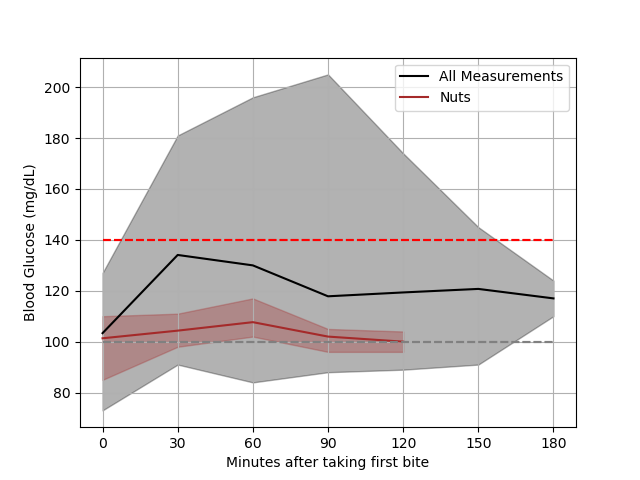
In this post I'll share the results of an experiment on myself to try and determine my personalized diet.  The approach is to take blood glucose measurements every 30 minutes from when you take your first bite of food.  I used the Care Touch glucose monitor as it had the cheapest cost combined for monitor and test strips (I've taken hundreds of measurements).  All of the plots below include an average measurement over 2 hours (dark line) with maximum and minimum measurements included as shaded regions.  The first plot is for all measurements and the following plots have an overlay of specific meal categories (including or excluding macronutrients or food groups).

I'll describe the first plot in detail to help get you oriented.  The vertical axis is blood glucose level.  The bottom axis is "Minutes after taking the first bite".  Before I started eating, I would take a measurement, that is represented as "0 minutes".  The average reading is a dark line.  The minimum and maximum levels create a shaded region.  All measurements fall somewhere in the shaded region.  All other plots overlay a similar plot on this first plot.  I'll put the plots in a progression of how I have tried to manage my blood sugar levels. Every plot has a dashed gray line at 100 mg/dL, since this is an expected level between meals.  The dashed red line at 140 mg/dL is a recommend upper limit.  You can see that I regularly exceed this limit.

The next plot is of desserts (ice cream, donuts, toaster strudels).  Occasionally I go on a "sweet fast", which is a logical thing to do looking at the higher average and overall levels. By eliminating these treats, I expected it would help lower my levels.
The next plot shows the result of excluding sweets.  This includes levels for all meals that didn't include sugar.  Surprisingly it turns out there are plenty of other meals that still cause a rise in levels.
 Before we figure out what is bad, let's find out what is good, or what foods do not cause a rise in blood glucose above the dashed red line.  My body does very well with nuts, seeds, salads and animal (e.g. eggs and bacon)

The salads all included dressing (mostly ranch dressing).  They also include romaine lettuce, spinach,  mixed greens,  tomatoes,  broccoli,  brussel sprouts,  bell peppers,  red onion,  chicken,  eggs,  carrots,  cucumber, artichoke hearts.  The salad that gave the maximum values also had sunflower seeds,  pepitas (pumpkin seeds), corn, peas and croutons.  The effect of seeds can be seen in the previous plot.

The "animal" meals were meals of only food from animals (e.g. bacon and eggs).  As expected these high protein, no carb meals had no impact on blood sugar.  It's important to note that blood glucose level is only one measure of health.  I'm sure that eating only bacon and eggs wouldn't be considered healthy.

 Meals with protein from animals and any assortment of plants (vegetables, fruit, nuts, seeds, potatoes) were good.  I've known that for a while since I always feel great after these meals.  The exception (excluded here) was pot roast with gravy.
 The following were a couple of unexpected results.  Fruit cause a rise in levels the first 30 minutes and then a drop below the initial levels after 60 to 90 minutes.  For this reason, I put fruit in the good category.
Regardless of what I ate, I made a valuable discovery.  GO FOR A WALK AFTER EATING.  If I exercised lightly after eating (take a walk for 15 or more minutes), I could keep my levels below 140 and my levels would even drop to normal.  Below is a plot for foods for which I measured my levels without exercising and then with exercising.  These include: pot roast, Mexican food, oatmeal, donuts, vegetable lasagna, s'mores.  Note that the time of exercise varied

One of the recommended foods for Type II diabetes is oatmeal.  I try to be healthy with my oatmeal so I eat it with raisins and almonds (no milk, sugar, or other sweetener).   The drop at 90-120 minutes is good but the initial spike was unexpected.  I ended up testing each ingredient separately.  Oatmeal was the prime culprit, raising my levels by around 30 for an hour (I ran out of strips).  The almonds reduced my levels over 90 minutes.  The raisins raised levels only slightly and only at 30 minutes.  
Here are some other results.

Mexican food is worse than average.  An exception was Chipotle's salad bowl (chicken, veggies, brown rice, pico de gaio, sour cream), though I only had one data point (a level of 111 after 30 minutes).


In an attempt to minimize dependencies, I had my wife make whole wheat bread.  She ground kernels of wheat into flour and made bread with water, salt, oil and yeast.  I then ate one slice of bread first thing in the morning with nothing else.  I was surprised at how much my blood glucose levels varied at 30 minutes (112 to 167).  My conclusion is that there is another factor affecting blood glucose besides "what you eat".  For example, the stress hormone cortisol elevates blood sugar and possibly that is the cause of this variation.  


Wednesday, May 20, 2015

The Species Diet

I came up with a diet called the Species diet.  With all the diets out there, why did I invent a new diet? It's because my whole life I've been a victim... of second hand dieting. From fake meat made with soy to brownies made with apple sauce.

What is a diet? The definition is "The kinds of food that a person eats". Our, in three words, "food people eat".

Why do we eat food? Imagine if your automobile used gasoline to create spare parts and put tread back on your tires. Besides providing raw energy, the gasoline would also need to provide raw materials.  It's the same with our bodies. We are continually regenerating cells, on average replacing our parts about every 7 years. We need food to do this. 

What if we could avoid the food provides the raw materials for the scars of life: wrinkles, gray hair, etc.?  Of course, that's a ridiculous idea.  However, that's what other diets are based on: the mistaken idea that you can be healthier by eliminating certain foods.

For example;
The paleo diet, don't eat grains, beans, peanuts
Atkins and South Beach - don't eat certain carbs
Vegan - don't eat meat or any animal protein
Jenny Craig - don't eat anything that Jenny Craig isn't selling.
Slimfast - don't eat anything that isn't a shake
Metafast - don't eat anything that resembles real food.

I say, forget all these restricting diets.

Remember the definition of diet: food people eat. There's a entirely different word for food you don't eat.  It's called Fasting. The definition of fasting is "To abstain from all or some kinds of food".  At least Slim-"fast" and Meta-"fast" got that right.

How do we make sure we get the raw materials we need?  In the early 19th century, William Prout, an English doctor and chemist identified the three principal constituents of food - pizza, diet coke, ... I mean protein, fat and carbohydrates.  Then Justus von Liebig, a German scientist added a couple of minerals and concocted the first baby formula. Babies fed exclusively on this first baby formula failed to thrive.

This is called the reductionist view of nutrition:  break food down into the chemical parts.  And it doesn't work.

To illustrate this problem, let's consider the menu with two choices:

Choice #1
Filet of beef/chicken/fish with
A side of Asparagus spears sauteed with roasted pecan nuts
Garlic mashed potatoes
A fresh bowl of cut strawberries, pineapple and mango.

Choice #2
Filet of protein with omega 3 fatty acids and essential amino acids
A side of carbohydrates high in fiber with folate, antioxidants sauteed with roasted betacarotenes and lutein
A fresh bowl of carbohydrates with magnesium, niacin, potassium.

Choice #1 is obviously more appetizing because it's food that comes from an animal or plant species. Each species is highly evolved. Plants collect nutrients with their roots and animals graze and forage. The result is tasty food.  The more species from which you get food, the greater the variety of nutrients. Thus the Species Diet.

What are the rules?
  1. You get a point for each species that you eat.  You decide when to reset your points. For me it's every day.
  2. If it's not a species, then it's zero points.  You decide what qualifies. For me, the species must be recognizable without reading a label.  You can still eat it, you just don't get points.
The goal is to get as many points as possible.

Example:
Breakfast: Bacon, eggs, orange (3 points)
Lunch: Apple, ham. Only 1 point since you have bacon (the same species) as ham.  

Does the species diet make any sense?
The focus is on eating unprocessed foods and the most points are available from eating fruits and vegetables since there aren't as many choices for meat. Makes sense to me.

In conclusion,
I may not be the most qualified person to invent a diet, but hopefully I convinced you that there it is a fun, healthy, non restricting way to eat. You can do it however you want. Just don't go crazy. Like the guy that tried to get points by eating a bald eagle. Of course, he got arrested and was convicted. At his sentencing, the judge said "I'm curious. What does a bald eagle taste like?" The man replied "a cross between a spotted owl and a California condor"

Monday, January 13, 2014

A caveman and a vegan walk into a bar...

Whenever I have what I think is a clever idea, I search it in Google and find that someone has usually done it better.  You can see what I mean here "a-caveman-and-a-vegan-walk-into-a-bar".  This is part 2 from a previous post on the subject of healthy eating (Orthorexia)

Vegan-like

A good friend tried to convert me to living on a plant based diet.  I don't use the word vegan, since it carries a political/religious-like connotation.  My friend is an engineer and presented an abundance of scientific evidence for his diet.  The main conclusion: we are not carnivores nor omnivores; we are instead herbivores.  Something about the length of my intestines and something about the physiology of pigs; I don't remember all of the details.  The enemy for him was cholesterol and he managed to get his cholesterol levels to negative 100 (I know there is no negative, but it seemed unhealthy to me, especially since he looked unhealthy).

Paleo Diet

I recently watched the documentary "The Perfect Human Diet".  They had a paleo-archeo-anthropological-dietary-geneticist person who did spectroscopic analysis of the stuff in caveman bones and said we resembled prehistoric carnivores (wolves, etc) more than prehistoric herbivores (deer, etc).  They did a distracting comparison with a football field where they said the last 1/2 inch represents modern history, and the previous 100 yards represents 2 million years.  The conclusion: we should eat like cavemen, or at least what the producers say that cavemen eat.

"Omnivore's Dilemma" and "In Defense of Food"

In the book Omnivore's Dilema, the author (Michael Pollan) makes an interesting point (before he totally freaked me out about the food industry).  Herbivores and carnivores don't think "Should I have Pizza, Mexican, Chinese food?"  Instead they eat what they are meant to eat.  Panda's eat bamboo and lions eat other animals.  The problem is that if they run out their usual diet, they starve.  Being an omnivore is much better since we are flexible and can eat almost anything [1].  The challenge isn't so much finding food, it's deciding if eating it will kill us.  Apparently we evolved our big brains to help us make this decision.  

It seems our "food rejection circuitry" is still active in-spite of an abundance of edible stuff.  The result is that just about all food gets a bad grade from someone: 
  • Vegans say all animal protein is bad (meat, eggs, dairy)
  • Paleo diet people say grains, beans are bad
  • Dietitians say to avoid processed foods
  • Scientists say that fresh produce grown with pesticides is bad.
There's not much left over to eat.  Fruit and nuts, I think.

Michael Pollan also wrote "In Defense of Food".   It's a much more balanced, reasonable approach to healthy eating for us omnivores.  Personally, I like the title.

Until science figures it all out, I guess I'll just stick with "The Word Of Wisdom" written 180 years ago.


Wednesday, March 23, 2011

Orthorexia

Have you ever had someone bring a veggie burger to your barbeque?  Have you ever had an "intervention" by a concerned friend or family member who preached about the "correctness" of their "healthy" diet?  Did they get defensive when you provided counter evidence to their dogma?  Or, maybe that person is you (If you feel defensive, it's okay.  That's a normal response).

These behaviors relate to the condition "orthorexia", which refers to an extreme obsession with only eating "healthy" (derives from the Greek "Ortho" for "correct or right" and "orexis" meaning "appetite").  When I was a kid, it was called "health nut". 

Not that eating healthy is a disorder.  There is plenty of evidence that a healthy diet can reduce the incidence of cancer, diabetes and cardiovascular disease.  This is how the term "Western Diseases" was coined.  However with all of the conflicting information on health, its not surprising that such a "disorder" could exist (it's not officially a disorder yet).

Here's a little self-test to determine if you or a loved one are orthorexic: Self-test from MetroActive

Here's a confessional from a recovering orthorexic (and the person who coined the term): Health Food Junkie